
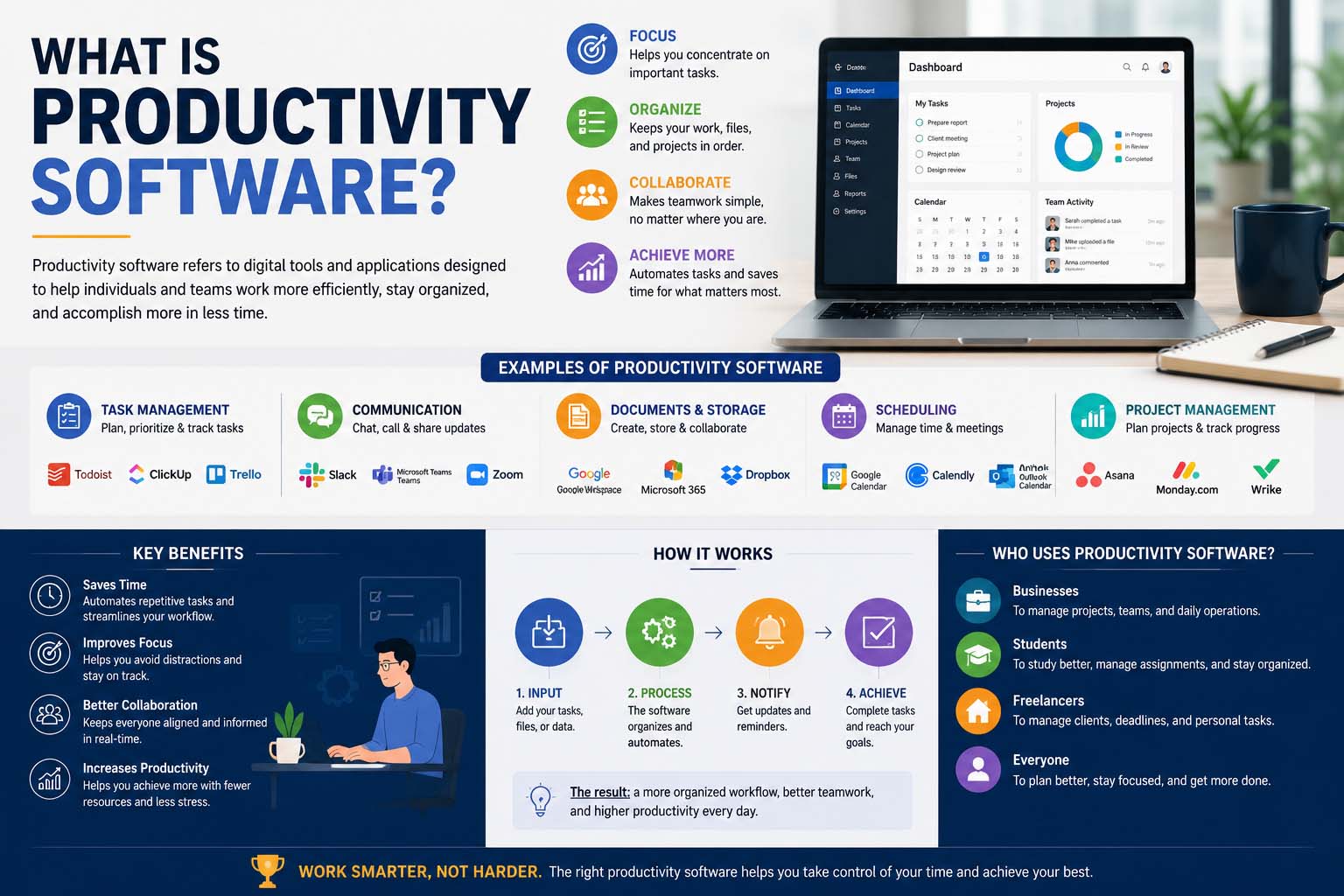
What Is Productivity Software? A Complete Guide for Businesses and Professionals
In today’s digital workplace, businesses rely on technology to complete tasks faster, improve collaboration, and manage projects more efficiently. For organizations asking what is productivity software, it is one of the most important categories of business applications.
If you’ve ever wondered about these tools, this guide explains everything you need to know. You’ll learn what does, common examples, business benefits, how to choose the right tools, and why they have become essential for organizations of every size.
What Is Productivity Software?
Productivity software refers to computer programs or cloud-based applications designed to help individuals and teams complete work more efficiently.
For example, these tools assist with everyday business activities such as:
- Writing documents
- Creating spreadsheets
- Managing emails
- Scheduling meetings
- Organizing projects
- Collaborating with coworkers
- Creating presentations
- Managing files
Ultimately, the primary goal is to save time, reduce manual work, and improve overall productivity. In addition, Managed IT Support Services can help businesses maintain the technology systems that support daily work.
What Is a Productivity Software?
Many beginners ask, what is a productivity software.
A application is any program that helps users perform work-related tasks more effectively.
Unlike entertainment or gaming, productivity tools focus on improving workflow, organization, communication, and task completion.
For example, they are commonly used by:
- Small businesses
- Large corporations
- Students
- Teachers
- Freelancers
- Entrepreneurs
- Government organizations
What Is Productivity Software and Why Does It Matter?
When someone asks, what is productivity software, they are usually trying to understand why businesses invest in these tools.
Modern workplaces generate large amounts of information every day.
Without, employees may struggle with:
- Organizing files
- Sharing information
- Managing deadlines
- Collaborating remotely
- Tracking projects
As a result, productivity simplifies these processes and helps teams work more efficiently.
What Is Considered Productivity Software?
Many applications fall under the category of productivity software.
For example, common categories include:
Word Processing Software
Used for:
- Reports
- Letters
- Business proposals
- Meeting notes
Spreadsheet Software
Helpful for:
- Budgets
- Financial analysis
- Data tracking
- Calculations
Presentation Software
Commonly used for:
- Business meetings
- Sales presentations
- Employee training
- Educational content
Project Management Tools
Allow teams to:
- Assign tasks
- Track progress
- Meet deadlines
- Improve collaboration
Note-Taking Applications
Useful for:
- Brainstorming
- Research
- Daily planning
- Meeting summaries
Calendar and Scheduling Tools
Help organize:
- Meetings
- Appointments
- Team schedules
- Project timelines
Moreover, IT Strategy Consulting can help businesses align their technology tools with operational goals.
What Is Productivity Software? Examples
Many people search for what is productivity software examples to better understand the concept.
For example, popular categories include software used for:
- Document creation
- Spreadsheet calculations
- Presentation design
- Email communication
- Team collaboration
- Video conferencing
- Cloud file storage
- Project management
- Task tracking
- Digital note-taking
Overall, these categories are used across nearly every industry to improve efficiency and teamwork.
Key Features of Productivity Software
Although features vary, many productivity tools include:
Cloud Access
Users can work from almost anywhere with an internet connection.
Collaboration
Multiple people can work on the same project simultaneously.
File Sharing
Documents can be shared quickly with coworkers and clients.
Automation
Some repetitive tasks can be automated, thereby saving time.
Security
Modern platforms often include encryption, user permissions, and secure backups.
Benefits of Productivity Software
Businesses of all sizes can benefit from productivity.
Increased Efficiency
Better Communication
Teams can communicate more effectively using shared documents and messaging tools.
Improved Organization
Files, schedules, and projects remain easier to manage.
Higher Productivity
Remote Work Support
Cloud-based tools allow employees to work from home or other locations.
Real-World Productivity Software Examples
Small Business
A local marketing agency uses:
- Documents for proposals
- Spreadsheets for budgeting
- Project management software for client work
As a result, this improves organization and client communication.
Retail Business
A retail company tracks:
- Inventory
- Employee schedules
- Sales reports
using productivity.
Education
Teachers use to:
- Create lesson plans
- Share assignments
- Track student progress
How to Choose the Right Productivity Software
Step 1: Identify Daily Tasks
Determine which activities consume the most time.
For example:
- Email management
- Scheduling
- Reporting
- Collaboration
Step 2: Set Your Budget
Some productivity tools are free, while others require monthly subscriptions.
Step 3: Consider Ease of Use
Choose software with an intuitive interface.
After all, employees learn new systems faster when they are user-friendly.
Step 4: Evaluate Collaboration Features
If your team works remotely, cloud collaboration may be essential.
Step 5: Review Security
Business information should be protected through:
- Secure logins
- Data encryption
- Backup options
Additionally, Digital Strategy Consulting can help modern businesses evaluate how digital tools support their wider objectives.
Business Strategy for Maximizing Productivity Software
Simply purchasing software is not enough.
Therefore, businesses should also:
Train Employees
Proper training improves adoption and efficiency.
Standardize Workflows
Create consistent processes for using documents, projects, and communication tools.
Integrate Systems
Connecting multiple applications reduces duplicate work.
Monitor Performance
Review productivity improvements regularly to identify opportunities for optimization.
In addition, a clear Business Level Strategy can help a company align operational tools with its competitive goals.
Common Productivity Software Mistakes
Avoid these common errors.
Choosing Too Many Tools
Using multiple overlapping applications can create confusion.
Ignoring Employee Training
Even powerful software provides little value if employees do not know how to use it.
Failing to Update Software
Regular updates improve security and performance.
Not Backing Up Data
Cloud backups and local backups help protect important business information.
Future Trends in Productivity Software
Technology continues to transform workplace productivity.
For example, emerging trends include:
- Artificial intelligence assistance
- Workflow automation
- Smart scheduling
- Voice commands
- Predictive analytics
- Enhanced collaboration features
Ultimately, these innovations help businesses work more efficiently while reducing repetitive tasks.
Frequently Asked Questions About Productivity Software
What Is Productivity Software?
Productivity consists of applications designed to help users complete work more efficiently through document creation, communication, project management, scheduling, and collaboration.
What Is a Productivity Software?
It is any application that improves personal or organizational by simplifying work tasks.
What Is Productivitysoftware Examples?
Examples include word processors, spreadsheets, presentation software, project management tools, calendars, note-taking applications, and collaboration platforms.
What Is Considered Productivity Software?
Any application that helps users organize, create, communicate, calculate, schedule, or collaborate efficiently is generally considered.
Why Is Productivity Software Important?
It helps businesses save time, improve teamwork, increase efficiency, and support better decision-making.
Is Productivitysoftware Only for Businesses?
No. Students, teachers, freelancers, nonprofit organizations, and individuals also use productivity for everyday tasks.
Conclusion
Understanding what is productivitysoftware is essential in today’s digital workplace. These applications help businesses, entrepreneurs, students, and professionals organize information, collaborate effectively, and complete tasks more efficiently.